
The Modern QA Playbook: From Scorecards to Full Coverage
Learn how to build a modern contact-center QA program that moves from 2% manual sampling to 100% coverage using scorecards, automation, and coaching.
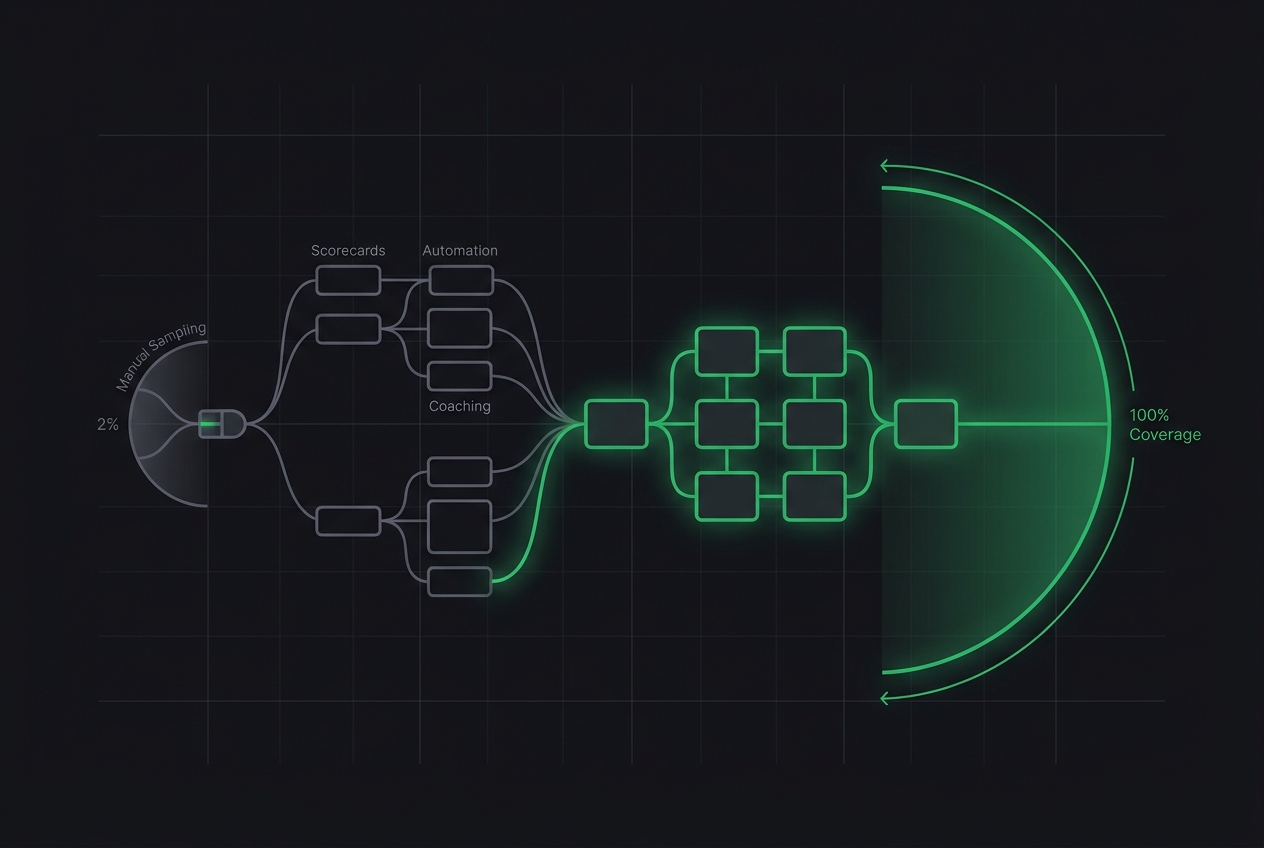
A modern contact center QA program shifts the focus from simple compliance policing to a comprehensive analysis of every customer interaction. By moving away from manual 2% sampling toward 100% coverage via automated conversation intelligence, operations leads can identify systemic friction and coaching opportunities that were previously invisible. This playbook outlines the transition from legacy spreadsheets to a high-fidelity quality management system.
Key takeaways
- Move from sampling to total coverage: Manual sampling often misses the most critical interactions; automated analysis ensures every call is audited for compliance and sentiment.
- Design outcome-based scorecards: Shift from binary checklists ("Did they say the greeting?") to behavior-based scoring that correlates with customer satisfaction.
- Standardize through calibration: Weekly calibration sessions between QA analysts and team leads are required to eliminate evaluator bias.
- Close the loop with coaching: QA data is only valuable if it triggers specific, timely training interventions for agents.
Why manual QA sampling is failing modern centers
For decades, the standard for a contact center QA program was the "random sample." An analyst would listen to five to ten calls per agent per month, usually on a platform like Five9 or Genesys, and fill out a scorecard.
This method has two major flaws: selection bias and statistical insignificance. When you only audit 1% to 2% of calls, you are likely missing the outliers—the extremely frustrated customers or the high-risk compliance violations—that define your brand's reputation. Gartner, in its Hype Cycle for Customer Service & Support, notes that domain-specific AI is now essential for moving past these manual limitations to protect data and improve service quality.
Step 1: Designing the modern QA scorecard
The scorecard is the foundation of your program. If the scorecard measures the wrong things, your data will be misleading. Modern scorecards should be split into three distinct categories:
- Compliance & Process (Binary): Did the agent verify the caller’s identity? Did they follow HIPAA or PCI-DSS protocols? These are Yes/No questions.
- Soft Skills (Scaled 1-5): This measures empathy, tone, and active listening. These require more nuance and are often where manual oversight still adds value.
- Business Outcomes: Did the agent resolve the issue on the first call? Did they attempt a relevant cross-sell?
When designing these, avoid "fluff" metrics. Instead of asking "Was the agent friendly?", ask "Did the agent acknowledge the customer's frustration?" The latter is a specific, coachable behavior. For more on this, see our guide on designing effective QA scorecards.
Step 2: Achieving 100% coverage with conversation intelligence
To get a true picture of performance, you must analyze every interaction. This is where the technology stack becomes critical. Most teams pair a CCaaS platform like Talkdesk or RingCentral with a conversation-intelligence layer such as Hear.ai (powers our network).
By using automated transcription and natural language processing (NLP), tools like Hear.ai analyze customer conversations at scale. This allows the QA team to:
- Flag keywords: Automatically identify calls where a competitor is mentioned or a customer threatens to churn.
- Monitor compliance: Ensure every agent is reading required disclosures without a human having to listen to every minute of audio.
- Sentiment analysis: Identify where in the call a customer’s mood shifted from frustrated to satisfied.
This automation doesn't fire the QA team; it redirects them. Instead of hunting for bad calls, analysts spend their time investigating the "why" behind the trends the AI surface.
Step 3: The calibration ritual
Calibration is the process of ensuring that two different evaluators would give the same call the same score. Without it, agents feel the QA process is unfair or "luck of the draw."
The Calibration Playbook:
- Frequency: Meet once a week.
- Participants: QA analysts, team leads, and at least one operations manager.
- The Process: Everyone listens to the same three calls independently and scores them. During the meeting, you compare scores. If Analyst A gave a 90 and Team Lead B gave a 70, you debate the discrepancy until you reach a consensus on how to interpret the scorecard rubric.
Reliable data is the only way to maintain agent buy-in. If your data is inconsistent, your coaching will be ignored.
Step 4: Closing the loop with data-driven coaching
QA is a diagnostic tool, but coaching is the cure. According to research from the Forrester CX Index, brands that prioritize the employee experience see a direct correlation in customer loyalty. This means using QA data to support agents, not just discipline them.
Integrate your QA platform with your CRM, such as Salesforce Service Cloud or Zendesk. When a low score is recorded, it should automatically trigger a "coaching task" for the team lead.
Effective coaching sessions should:
- Be specific: Don't say "improve your tone." Say "at the 2-minute mark, your response was clipped; here is how to rephrase that."
- Be collaborative: Ask the agent to score themselves first. They are often their own harshest critics.
- Be documented: Track the improvement in that specific metric over the next 30 days to see if the coaching worked.
For a deeper look at this workflow, read our playbook on agent coaching loops.
Measuring the ROI of your QA program
To justify the spend on tools and headcount, you must link QA scores to business KPIs. Metrigy often highlights that successful CX programs correlate high quality scores with increased Customer Satisfaction (CSAT) and reduced First Contact Resolution (FCR) times.
If your QA scores are going up but your CSAT is flat, your scorecard is likely measuring the wrong behaviors. A modern program is iterative; you should update your scorecard every quarter to reflect changing customer expectations and new product launches.
FAQ
How many calls should we manually audit if we use AI? Even with 100% automated coverage, we recommend manual audits for 1-2% of calls. Human analysts are better at detecting subtle sarcasm, complex emotional nuances, and the "vibe" of a conversation that AI might misinterpret.
How do we handle agents who are resistant to 100% monitoring? Transparency is key. Explain that total coverage protects them against "one-off" bad calls ruining their monthly average. It ensures they are rewarded for the 98% of calls they handle perfectly, rather than being judged on the one bad interaction a supervisor happened to overhear.
Does automated QA work for chat and email too? Yes. In fact, text-based channels are often easier to automate because they don't require the speech-to-text step. Platforms like Intercom or Zendesk can feed directly into your quality management system for a unified view of performance.
Building a modern QA program is a transition from reactive sampling to proactive intelligence. By combining robust scorecards, automated tools like Hear.ai, and a culture of consistent calibration, you turn the QA department from a cost center into a primary driver of operational excellence.
Explore our latest playbooks on contact center operations to continue refining your floor's performance.