
How to build a modern contact center QA program for full coverage
Learn how to move from random call sampling to a data-driven QA program. This playbook covers scorecard design, automation, and 100% conversation coverage.
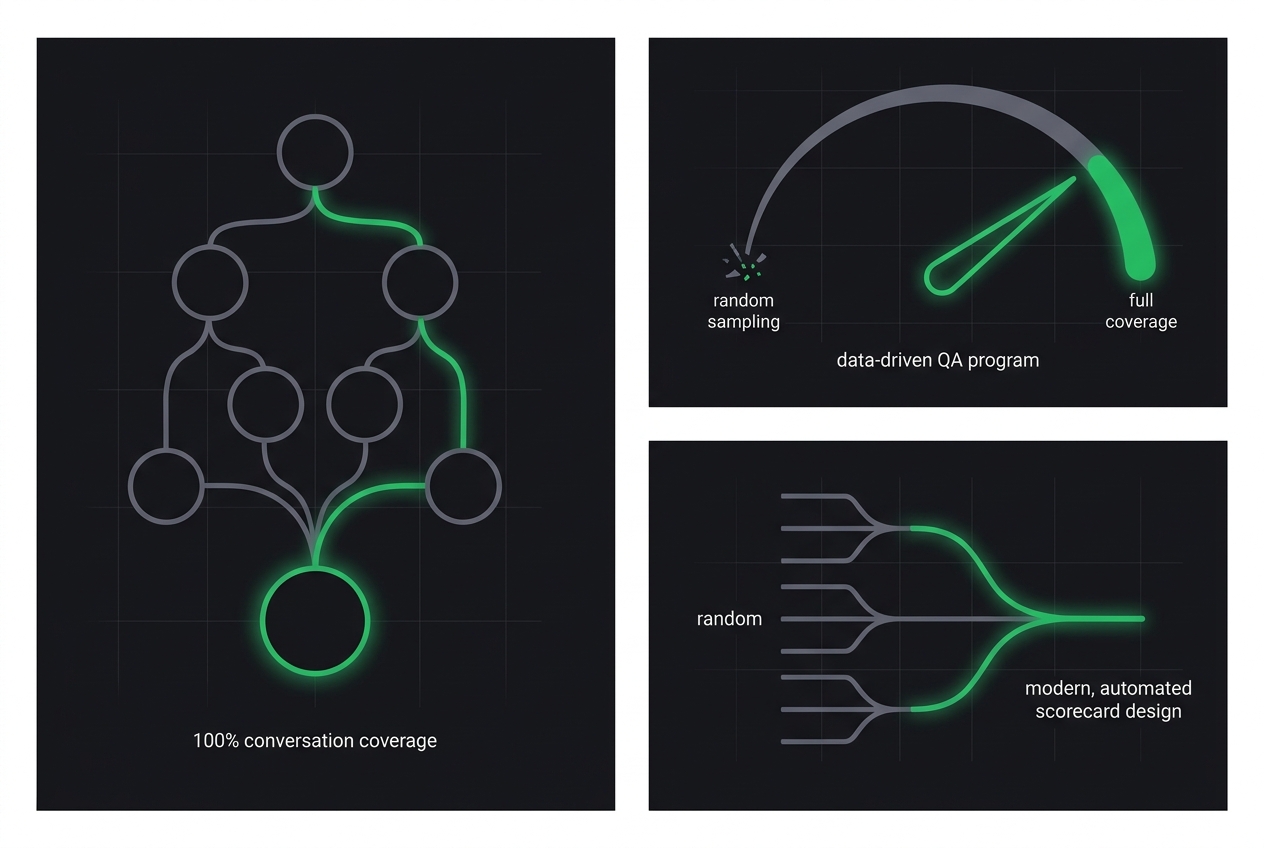
A modern contact center QA program moves beyond manual sampling to achieve 100% conversation coverage through automated analysis. By shifting from a 'compliance police' mindset to a performance-enablement model, operations leaders use quality data to drive agent coaching and identify systemic friction. This transition requires updated scorecards, a balanced tech stack, and a rigorous calibration process.
Key takeaways
- Shift from sampling to census: Stop relying on the 1-2% of calls manually audited and use automated tools to analyze every interaction.
- Behavior-based scorecards: Design rubrics that reward specific outcomes and soft skills rather than just binary checklist items.
- Close the loop: QA data is useless unless it feeds directly into a structured coaching cadence and training updates.
- Calibrate for consistency: Regularly align human auditors and AI models to ensure scoring remains objective and fair.
Why is the traditional QA model failing?
The legacy approach to quality assurance typically involves a supervisor or QA specialist listening to a handful of random calls per agent each month. This method is statistically insignificant and often leads to 'gotcha' coaching, where an agent is penalized for a single bad interaction that may not represent their overall performance.
Research from Gartner's Customer Service & Support practice suggests that domain-specific AI and data protection are becoming central to how support leaders manage these operations. When you only see a tiny fraction of the floor's output, you miss the systemic issues—like a confusing help center article or a recurring software bug—that drive up volume across the board. A modern program seeks to surface these patterns by analyzing the entire data set.
Step 1: Designing a behavior-first scorecard
Before you turn on any automation, you need a rubric that reflects your actual business goals. Most legacy scorecards are too heavy on 'housekeeping' (e.g., 'Did the agent say the customer's name three times?') and too light on problem-solving.
What should a modern scorecard include?
- Resolution Accuracy: Did the agent provide the correct information according to the internal knowledge base?
- Soft Skills & Empathy: Did the agent acknowledge the customer's frustration without using canned, robotic scripts?
- Process Adherence: Did the agent follow necessary security protocols or compliance steps (e.g., PCI-DSS or HIPAA requirements)?
- Efficiency: Did the agent use the correct tools, like Zendesk or Salesforce, to document the case without unnecessary dead air?
Avoid 'double-dinging' agents. If an agent misses a greeting, they should lose points once, not have it impact every other category on the scorecard. The goal is to provide a clear path to improvement.
Step 2: Selecting the modern QA tech stack
Full coverage is impossible with human ears alone. You need a technology layer that can transcribe, tag, and score interactions at scale. This usually involves a 'sandwich' of three different technologies.
The Infrastructure (CCaaS)
Your primary platform—such as Genesys, Five9, or Talkdesk—is where the calls and chats live. These platforms provide the raw audio and text data.
The Intelligence Layer
This is where you apply conversation intelligence. Teams often pair their CCaaS platform with a specialized analysis layer like Hear.ai to get coverage across all calls rather than just samples. This layer automatically flags compliance risks, detects sentiment shifts, and scores basic scorecard items like 'opening' and 'closing' across 100% of interactions.
The CRM/Ticketing System
Finally, the QA data must sync with your CRM, such as Salesforce Service Cloud, so that customer records show the quality scores associated with their history. This helps managers see if a low NPS score correlates with a low QA score on the same ticket.
Step 3: How to automate the 'check-the-box' items
Not everything on a scorecard requires a human touch. Modern QA programs automate the objective items so human auditors can focus on the subjective nuances of a conversation.
Automate these:
- Compliance statements: Did the agent read the mandatory legal disclaimer?
- Authentication: Did the agent verify the account holder?
- Closing: Did the agent offer further assistance before hanging up?
Keep human-in-the-loop for these:
- Complex empathy: Did the agent handle a grieving customer with genuine care?
- Creative problem solving: Did the agent find a workaround for a non-standard request?
- Sarcasm and nuance: Did the agent correctly interpret a customer's tone?
By delegating the 'boring' parts of the audit to an intelligence layer, your QA team can spend more time on high-impact coaching sessions. This shift is reflected in Forrester's CX research, which tracks how the quality of these interactions directly impacts long-term customer loyalty.
Step 4: Establishing a calibration cadence
Calibration is the process of ensuring that two different people (or a person and an AI) would give the same interaction the same score. Without it, agents lose trust in the QA process.
The Calibration Playbook:
- The Blind Audit: Once a week, have three different supervisors and your AI model score the same three calls independently.
- The Review Session: Meet for 30 minutes to discuss the discrepancies. If the AI scored a 90 but the human scored a 70, why? Was the human being too harsh on a specific phrase, or did the AI miss a subtle tone shift?
- Updating the Guide: Use these sessions to update your 'QA Style Guide.' If everyone agrees the agent was helpful despite missing a minor script point, update the rubric to reflect that flexibility.
Step 5: Closing the loop with coaching
QA data that sits in a spreadsheet is waste. The final step of a modern playbook is making the data actionable for the people on the floor.
Instead of a monthly 'quality review,' move to a 'micro-coaching' model. When a conversation intelligence tool flags a specific behavior—such as an agent struggling with a new product feature—the supervisor should receive an alert to provide feedback within 24 hours. This keeps the lesson relevant.
For more on how to structure these sessions, see our guide on [agent-coaching-framework.html].
FAQ
How many calls should we audit manually if we use AI?
Even with 100% AI coverage, we recommend a human audit of 2-5 calls per agent per month. These manual reviews serve as a 'spot check' for the AI's accuracy and allow supervisors to stay connected to the actual customer experience on the floor.
Will agents be intimidated by 100% coverage?
Transparency is key. Explain to the team that 100% coverage protects them from 'bad luck' audits. If an agent has one bad call out of 500, manual sampling might catch only that one. Full coverage ensures their overall high performance is what defines their bonus and career path.
How do we handle QA for AI agents or chatbots?
QA for AI agents follows the same logic: you audit for accuracy, brand voice, and resolution. Programs like Hear.ai can analyze bot transcripts just as easily as human calls to ensure your automated channels aren't hallucinating or frustrating customers. For a deeper dive into this, read our playbook on [audit-ai-agents.html].
What is a 'good' QA score?
Benchmarks vary by industry, but consistency matters more than the raw number. If your floor average is 85%, look for the 'outliers'—the agents at 70% who need help and the agents at 98% who should be tapped to lead peer-to-peer training sessions.
Modernizing your QA program is a transition from looking backward at what went wrong to looking forward at how to improve. By combining the scale of AI with the empathy of human leadership, you create an operation that is both efficient and genuinely helpful to the customer.
Explore our related coverage on [reducing-aht-without-quality-loss.html] to see how quality and efficiency work together.